Generative AI2026-09-29 07:42:14China report says generative AI users topped 700 million in the first half of 2026China Internet Network Information Center’s Policy and International Cooperation Institute released the 2026 Report on the Development of Generative Artificial Intelligence Applications at the 2026 (7th) China Internet Basic Resources Conference on Sept. 29. The report said China’s generative AI user base exceeded 700 million in the first half of 2026, with penetration rising above 50.0%. Intelligent Q&A remained the biggest use case. According to the report, 76.0% of users relied on generative AI to answer questions. The shares of users applying it to image or video processing, text drafting and work summaries, meeting minutes, and PPT creation were 47.8%, 37.6%, and 32.5%, respectively. Usage frequency for AI general assistants and AI productivity office tools both rose by more than 100% year over year. The report also covered computing power, industrial adoption, and financing. As of June 2026, China’s intelligent computing capacity reached 2,185 EFLOPS, up 177% from a year earlier, while the country’s first fully domestic 100,000-card AI super cluster had entered operation. It added that AI-related investment and financing totaled 1,255 deals worth about 250.14 billion yuan during the same period.180
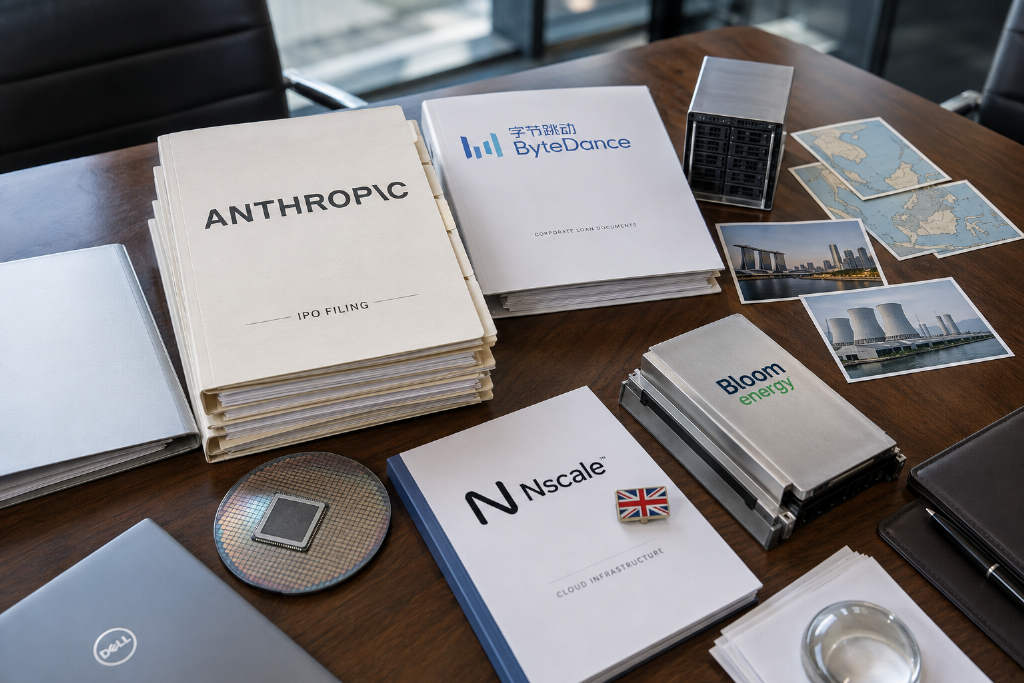
Anthropic2026-09-05 11:52:25Anthropic weighs a $2 trillion IPO as ByteDance secures roughly $30 billion loanWhiteLine Daily, published by WuBlockchain, highlighted a cluster of major financing and capital-markets developments tied to the AI sector. The report said Anthropic, developer of Claude, is nearing a decision on Morgan Stanley and Goldman Sachs as lead underwriters for an initial public offering and could publicly file as soon as next week. The company’s discussed valuation is about $2 trillion, while the Financial Times said its annualized revenue in July was about $65 billion, below some investors’ prior expectation of around $80 billion. The same digest said ByteDance has obtained roughly $30 billion in financing, with Reuters putting the size at $29.6 billion from nearly 30 banks. The loan is unsecured, carries a three-year term with a possible two-year extension, and more than 60% of the facility was contributed by Bank of China. People familiar with the matter said the funds are mainly expected to support AI spending, including chip purchases and data-center construction in Southeast Asia. Elsewhere, Bloomberg reported that UK-based AI cloud infrastructure firm Nscale is seeking up to $3.5 billion in pre-IPO financing, including as much as $1.5 billion in convertible debt and a potential roughly $2 billion investment from Nvidia. WhiteLine Daily also noted that Bloom Energy will join the S&P 500, while Dell Technologies, Palo Alto Networks, Arista Networks and Sandisk are being added to the S&P 100.910
Nvidia2026-08-27 01:00:24Jensen Huang defends Nvidia’s AI financing push, says frontier labs are a rare investment opportunityNvidia CEO Jensen Huang pushed back on criticism of the company’s expanding financing support for the AI ecosystem during an appearance on CNBC’s Mad Money, arguing that critics are missing the capital profile of the industry. Huang said the first wave of frontier AI startups requires billions of dollars to get off the ground and hundreds of billions more before becoming profitable, making large-scale funding a built-in feature of AI development and deployment rather than an anomaly. Nvidia has already invested in model developers including OpenAI and Anthropic, as well as newer cloud providers that rent out Nvidia compute. The company is also backing data center projects. Huang said Nvidia is providing $105 billion in support for a large compute campus in Ohio leased by OpenAI, and is working with major Wall Street financial institutions on plans to arrange up to $500 billion in financing for data centers. Some critics have described those structures as a form of circular financing, where a company funds customers who then use part of that capital to buy its products, potentially propping up demand and revenue. Huang rejected that framing, saying frontier AI labs represent a “once-in-a-generation” investment opportunity and that Nvidia sees value in becoming both an equity investor and a strategic partner while helping expand the ecosystem built on its platform. He also said the risk is low because compute infrastructure can be redirected to other customers and workloads if a supported company runs into trouble.900
Federal Reser2026-08-25 10:19:09Interview says stronger AI could push the Fed closer to rate cuts as Treasury supply and tech borrowing compete for liquidityMarsBit published a long-form interview from 168X War Room that tied Federal Reserve policy, U.S. Treasury funding pressure, and the rapid buildout of AI capital spending into one macro frame. The guest, Tiezhu, argued that the Fed’s legal independence remains intact but its room to maneuver has narrowed as debt-market realities become harder to ignore. In his view, the central bank’s practical endgame is not simply inflation or employment, but preserving the U.S. Treasury market when sovereign debt has become too large to sit in the background. He said rate hikes can suppress inflation spikes but cannot lower the underlying level of inflation if fiscal spending keeps flowing, and he rejected the idea of further hikes later this year. His base case is that September stays on hold, while the odds of a year-end rate cut stand at 60%. He also argued that stronger AI investment makes cuts more, not less, likely because high rates do little to restrain the most profitable AI businesses while putting heavier pressure on real estate, small businesses, and other rate-sensitive sectors. The interview also focused on AI moving into a credit-expansion phase through SPVs, project finance, GPU financing, private credit, and long-dated corporate borrowing. On China, the discussion touched on Alibaba’s planned HK$80 billion AI capital raise, open-source model competition, and broader policy support for technology investment.1160
CITIC Securit2026-08-23 12:38:22CITIC Securities Says Bigger Treasury Buybacks Show U.S. Is Avoiding an Abrupt Financial TighteningCITIC Securities said in a market note that margin financing in China’s A-share market and exchange-traded fund flows are moving in opposite directions, with liquidation pressure not fully over even as volatility has started to ease. The brokerage added that selling from earlier dip buyers seeking to break even may limit the pace of any rebound. On U.S. rates, the note said the 10-year Treasury has been fluctuating around 4.7%, reflecting two forces: implied inflation and AI-related debt financing, both of which have pushed up long-end yields. CITIC Securities also said the U.S. Treasury has stepped up bond buybacks, a sign policymakers do not want sharply tighter financial conditions to damage the AI sector and the broader economy. In its view, the pressure from rates on equities remains relatively manageable. At the strategy level, the firm described the current recovery trade as having support on the downside but limited room on the upside. It said policymakers have shown a clear willingness to stabilize the market, but fresh capital has yet to form a unified force, leaving trading dominated by existing funds. A stronger catalyst would be needed for indexes to break higher.1050
Bitget2026-08-21 02:49:52Bitget UEX daily: Treasury buybacks set to expand, Anthropic nears IPO filing, U.S. stocks give back gainsBitget’s Aug. 21 UEX daily report tracked a market driven by Treasury buyback plans, higher oil prices, Jackson Hole expectations and fresh AI financing headlines. U.S. Treasury Secretary Scott Bessent said long-dated Treasury buybacks would be expanded by at least twofold, with a single operation next month possibly topping $4 billion, while new fiscal consolidation measures could be unveiled as soon as this weekend or early next week. The report also said Anthropic could publicly file for an IPO by the end of August, with fundraising that may match or exceed SpaceX’s prior record, and noted Broadcom’s reported talks on roughly $100 billion of AI-related debt financing. Across markets, U.S. equities retreated as the Dow, S&P 500 and Nasdaq all closed lower, while crypto remained firm. BTC rose about 5.88% to around $73,600, ETH gained 3.04% to about $2,338, and total crypto market capitalization climbed to $2.55 trillion. The report linked the move to crypto policy expectations, lingering momentum from White House discussions, ETF inflows and short covering. It also highlighted Grayscale’s Zcash research, CoinDesk’s note on a possible Bitcoin golden cross, and the upcoming Aug. 28 Jackson Hole speech from Federal Reserve Chair Kevin Warsh as key events for traders to monitor.1330
Alphabet2026-08-19 13:50:00Alphabet lines up first Australian dollar bond sale as AI funding drive spills into credit marketsAlphabet is preparing its first Australian dollar bond offering, a move that PANews, citing Bloomberg, describes as part of a much wider shift in how large cloud companies are paying for the AI buildout. The planned deal is sized at about A$5 billion, or roughly $3.6 billion, across 3-year, 5-year, 10-year and 20-year maturities, with fixed and floating structures on the short end and fixed-rate tranches on the long end. According to the report, the financing push comes as Alphabet’s second-quarter free cash flow fell to negative $5.9 billion, the first quarterly negative reading since it went public, while its full-year capital expenditure guidance rose to $195 billion-$205 billion, nearly six times the 2022 level. The article places that deal in a broader market context. Goldman estimates global AI-linked debt issuance has reached $489 billion so far, already above the full-year 2025 total. In August, U.S. investment-grade corporate bond supply hit $145.2 billion, breaking the previous August record of $136 billion set in 2020. Morgan Stanley estimates global data center construction will require $2.9 trillion in cumulative investment by 2028, excluding power infrastructure, leaving a $1.5 trillion gap after internal operating cash flow coverage. Bank of America strategist Michael Hartnett has argued that shorting AI-related bonds is now a preferred hedge. The report says the concern is not only supply pressure on bond prices, but also the knock-on effect on yields, duration supply and broader market liquidity.1240
Policy and Re2026-08-19 04:30:00Rising global bond yields and AI financing concerns drive a broad sell-off in U.S. tech stocksU.S. stocks fell for a third straight session Tuesday as higher long-term bond yields put fresh pressure on richly valued technology names. The Nasdaq Composite dropped 1.33%, underperforming the Dow Jones Industrial Average and the S&P 500, while the 30-year U.S. Treasury yield briefly touched 5.338%, its highest level since 2007. The move was part of a wider global bond sell-off that also pushed long-dated yields higher in France, Germany, Japan and the U.K. Markets are increasingly focused on the growing debt burden tied to artificial intelligence expansion. According to figures cited in the report, AI-related bond issuance has reached $489 billion so far this year, well above an earlier full-year 2025 estimate of roughly $322 billion, while The Wall Street Journal reported that nine major technology companies have about $3 trillion in off-balance-sheet AI commitments. That backdrop hit semiconductors, memory, optical communications and AI cloud-service providers especially hard. Investors are also weighing fiscal deficits, oil-driven inflation risks tied to the Iran situation, and a heavy event calendar that includes U.S. tariffs on some Canadian products, a 20-year Treasury auction, Federal Reserve minutes and China’s one-year LPR decision.1780